Gaza Herald_The Guardian said that the scale of abuse, torture, and deaths inside Israeli prisons involving Palestinian detainees has drawn comparisons to the notorious Abu Ghraib prison scandal near Baghdad, known for its brutal violence and the deliberate humiliation of prisoners.
The report adds to mounting international scrutiny of Israel’s treatment of Palestinian detainees, as human rights organizations and United Nations experts continue to call for independent investigations into allegations of torture, arbitrary detention, enforced disappearances, and deaths in custody. Rights advocates have urged greater accountability and renewed efforts to ensure compliance with international humanitarian and human rights law, warning that continued impunity risks further entrenching abuses against Palestinian prisoners.
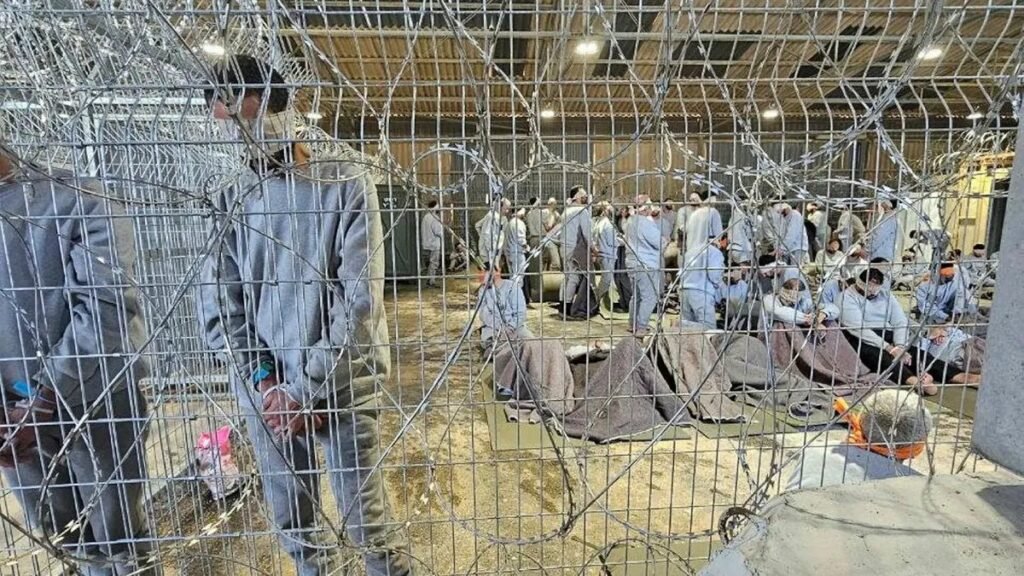
The treatment of Palestinian detainees inside Israeli prisons increasingly recalls the abuse documented at Iraq’s Abu Ghraib prison, according to an analysis published by The Guardian, which argues that reports of torture, degrading treatment, and deaths in custody reveal a broader system of abuse.
The newspaper pointed to a photograph shared earlier this month by an Israeli soldier on social media showing a Palestinian detainee from Gaza lying face down, stripped to his underwear and tied to a wooden board and metal pole. The image was accompanied by a Hebrew caption reading, “Good morning.”
According to The Guardian, the photograph evoked the infamous images from Abu Ghraib, citing similarities in the deliberate humiliation of detainees, the use of sexual degradation, and the apparent practice of documenting abuse as a form of souvenir.
The report argued that such incidents are not isolated and did not begin with the current war, although it said their frequency has increased significantly. It described Israel’s use of administrative detention and alleged mistreatment of Palestinian prisoners as part of a long-standing system that deprives detainees of fundamental rights while serving as a means of intimidation and collective punishment.
The newspaper also highlighted Israel’s long-standing policy of withholding the bodies of deceased Palestinians from their families. According to the report, some bodies are buried in numbered graves inside closed military zones, while others remain in refrigerated facilities. It added that around 100 Palestinians have died in Israeli custody without public disclosure of the circumstances surrounding their deaths.
The article further examined the issue of missing Palestinians from Gaza, citing eyewitness accounts that Israeli forces detained numerous individuals whose arrests were never officially documented. Israeli human rights organization HaMoked classifies such cases as enforced disappearances and is working to determine the fate of nearly 2,000 Palestinians believed to remain unaccounted for.
According to The Guardian, these cases reflect a broader system that has subjected Palestinians to overlapping forms of physical and psychological trauma. The report argued that beyond the physical abuse, the institutional framework enabling such practices seeks to undermine personal dignity and the sense of autonomy by extending state control over Palestinians both in life and after death.
The newspaper also noted that many detainees are journalists, physicians, and civil society figures who play prominent roles within Palestinian society. It suggested that their detention carries a broader symbolic impact by targeting individuals viewed as essential to the social fabric of Palestinian life.
The report concluded that many of these alleged abuses have been carried out openly. It cited photographs and videos documenting the treatment of Palestinian detainees, including allegations of sexual abuse and images of prisoners restrained in their underwear, as well as documentation collected by human rights organizations. According to the newspaper, some of the material has been shared publicly by Israeli soldiers on social media and, in some cases, defended or praised by Israeli political figures.